
Today, rather than daily informational tidbits, I am writing about Israel’s Pager Walkie Talkie Op because I can’t stop thinking about it, and because I think it is central to my project. I feel very conflicted about the attack. On the one hand, it feels like an enormous escalation at a time when I would think we would want to de-escalate. Not to mention whether or not I personally support such an attack. To clarify my feelings, I turned to the communities speaking loudest about the attack.
After looking at Hezbollah’s own news and various regional reporters’ accounts, they claim that a majority of those injured are Hezbollah militants. This fact has polarized people across the world. In the West, it doesn’t really mean much that it was Hezbollah. The West is thus focused on the attack itself without real attachment to who it was against and what those people might have done, and thus to them it does seem violent and criminal. To Iranians, it represents justice against regime mercenaries who have beaten and murdered Iranians without cause and continue to work on behest of the Iranian regime to hurt Iranians.

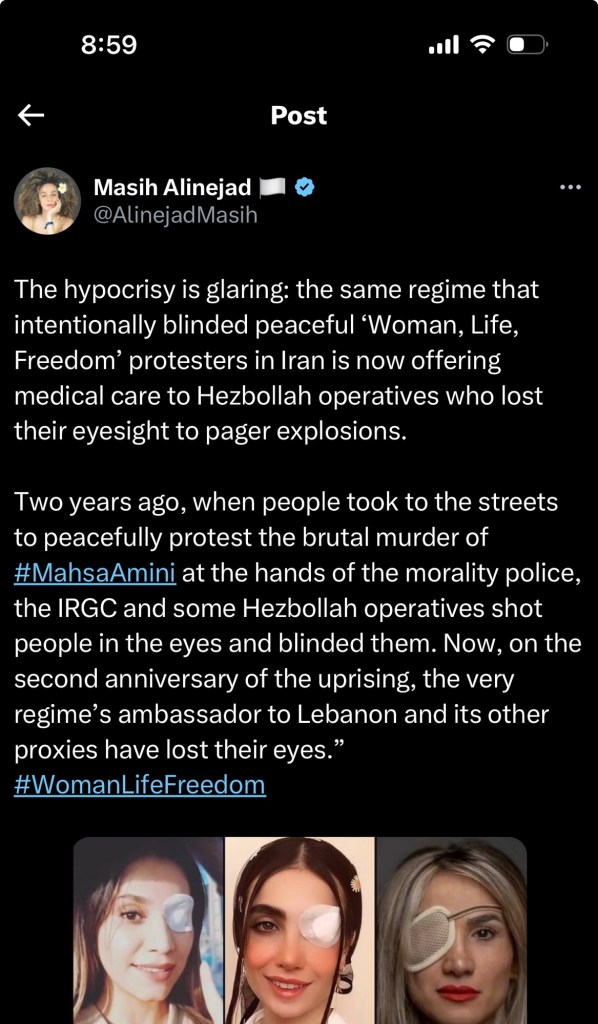
For example, the photo above has been making the rounds on the internet. It features Iranian protesters with missing eyes who were deliberately blinded by Hezbollah militants for protesting the death of Mahsa Amini during the ‘22 Women, Freedom, Life Uprising. Many note that it is two years almost to the day of Amini’s death. Iranians on the whole have been Pro-Israel’s war against Hamas (not Palestinians) and Iran’s other proxy militias. From what I’ve seen, they also have a deep understanding of the tactical challenges any military would have in fighting these IRGC funded militias. For many reasons, I can understand and appreciate their position on the device attacks.
Similarly, many Israelis see the attack as justified given Hezbollah’s ten month bombardment of the North which has displaced 100,000 Israelis and killed many including 12 Druze children playing soccer. We may not hear about it, but that’s because daily rocket barrages are par for the course in Israel. That doesn’t mean the people living there aren’t deeply traumatized and aren’t suffering. To them, in the wake of the terror they have lived under, the attack feels celebratory: it delivered a huge blow to Hezbollah — materially and psychologically — while seemingly not resorting to mass shelling of the region.
In terms of my own thoughts, I’ll first share a few logic-based assessments that don’t include my personal feelings on things like whether the attack is worth the emotional trauma on the civilians among which Hezbollah lives. I think it was a brilliant tactical way to cripple a communication network and deal an enormous mental blow to Hezbollah and its regional allies, while minimizing collateral damage. I won’t get into a discussion of the mafia-like regional psyche of the countries involved, but it’s a huge reason for why I feel this attack was powerful. Now, some people might claim that the attack didn’t limit collateral damage, and it wasn’t tactical. Around 99% of the pagers were on Hezbollah militants at the time of detonation. To support the argument that Israel sought to limit the scope of attack, there is strong evidence that the pagers are kept on a militant’s person at all times, especially during wartime.
When switching from cell phones to pagers, Hezbollah’s leader Hassan Nasrallah ordered all militants to carry their pagers on them at all times. The NYT reports that Israel set up a shell company to appear as a pager manufacturer so that they could specifically run this scheme on Hezbollah. This implies a more focused targeting as they sold these directly to the group. Side note, people are spreading rumors to the effect that non-combatants also had similar pagers and so innocent people were harmed. These specific pagers made for Hezbollah were hand doctored with explosives. If Israel didnt send you a Hezbollah pager, then you have nothing to worry about. Furthermore, the pagers were on a closed communication loop, providing even more support that it was a tactical attack. These pagers only function within Hezbollah’s technoglocial intranet. AT&T isn’t hosting the communication network for Hezbollah’s pagers. They have their own. In terms of damage potential, the explosives appear not to exceed five inches to a foot from source of detonation, and upon detonation, it’s not as though they shoot shrapnel. The limited blast radius also supports a tactical reading of the attack.
People like Edward Snowden argue that the operation is a new dawn in warfare, and we are all at risk! What about our cell phones and what about our iPads. If you think someone has the resources and the motive to explode any of your communication devices, you either have a more inflated sense of your importance or you are part of a warring tribe. Israel basically Trojan horse pagered Hezbollah. This is not new technology. It was certainly an unexpected and shocking use of it, however, which seems to be even scarier for people.
I can espouse all kinds of moral positions on who it should be fair to kill (if anyone) and what is a bridge too far. There’s several issues I am having with this line of thinking. There is the moralist in me who feels I know what is an appropriate response for a country to take against a foe, and then there’s the me that knows the variables of this war.
It seems like we are trying to justify war only when we feel we’ve fought it honorably. Isn’t that why we have all of our protocols and laws and rules that tell us a certain number of civilians are acceptable to kill? If we want to keep a morality, we need to rethink it in different terms. I’m not sure any war is ever entirely moral, so I don’t feel it’s possible or my place to justify it. Does that mean we have no guidelines and anything goes? Does that mean we have to accept Hamas’ behavior?
That’s a bit of an extreme statement. Even though no war is ever moral, since we don’t plan to, as Robert Jordan called it “walk the way of the leaf” and commit to absolute nonviolence even at the risk of our own eradication, we have to engage in war, and if our attackers don’t have morals or won’t follow the morals we think are worth following, we are left looking for ways not to abandon our own core values while also not allowing those who hate us to exploit our morality. We cannot be slaves to our own morality, in other words — not through those who want us dead and not through our own toxic egos.
But it is fine and well for me in my office where no rockets fall and where no safe rooms wait to think about whether the pager attack is moral. All I can do is continue to study the information as it comes in and to do everything in my power to shift the social consensus from blood and anger toward peace.
A reminder: Deligitimizing Jewish or Palestinian connections to the homeland is a bad look. Peace is the right look. Let’s focus on that.

 Snail Ask Why
Leave a comment