I’ve seen a lot of sitting shiva for Sinwar posts. I keep remembering Palestinian social persona Nerdeen Kiswani’s: “To stop Palestinian resistance, you have to kill every Palestinian on earth.” She says that like she thinks it’s impossible to kill every Palestinian on earth. Unlike her, I come from a people who well know it’s possible to have every one of us killed. Our freedom does not depend on our deaths.
I watched her lose a piece of herself when Piers Morgan got her to agree it was bad to shout Death to America. I want to tell Nerdeen there is something wrong with her choices if condemning that chant hurts her brand. I want to tell her you cannot sacrifice your life in battle only to call it a genocide.
Elsewhere, Palestinians gathered in the streets of the West Bank to mourn Yahya Sinwar.
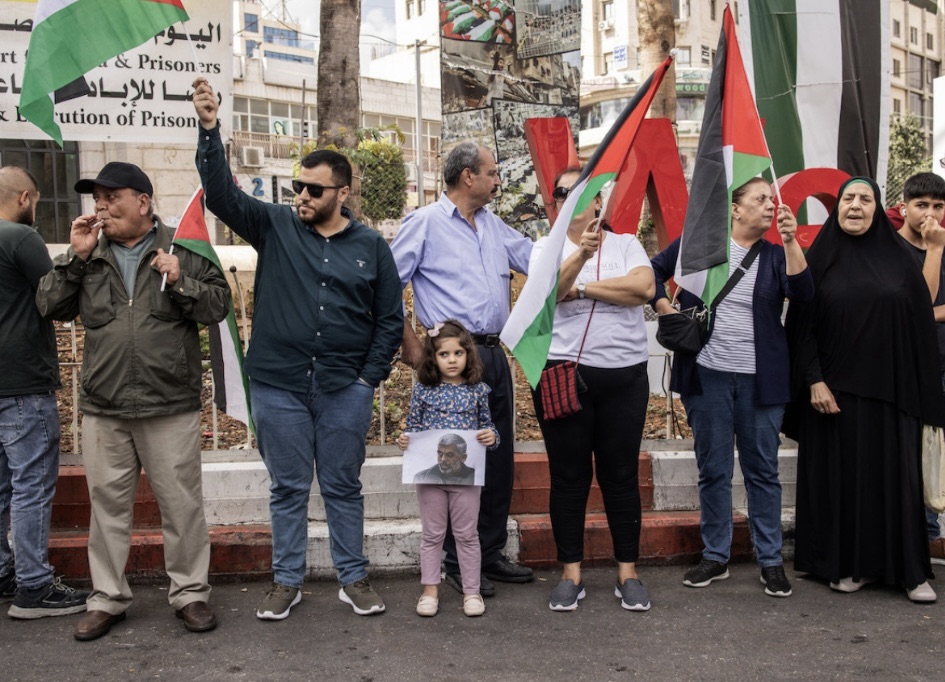
This feels like a betrayal. Maybe Palestinians have to be performative. It’s like that in North Korea. When Kim Il-sung died, people clung to one another in groups, crying in public grief circles. They had to perform their sadness so that their local Inminban wouldn’t mark them for questioning by the police.
How can a small child be standing with a portrait of Yahya Sinwar? She is a kid. Her parents gave her a photo of a maniac. Not the Palestinian Resistance — I can respect resistance. They gave her a photo of a man who also butchered thousands of her people — not only Jews, not only the numerous other nationalities he also ordered murdered. She does not know any better. But she’s learning. Someone has made sure of it. Today she’s learned to mourn as a hero the man who said 100,000 dead Palestinians is a drop in the bucket against the destruction of Israel.
Does that sound grotesque? Of course it does. There is something grotesque in celebrating Sinwar’s death: because it is death, because of who Sinwar was, and because celebrating the death of an enemy feels contradictory to me. I’ll admit I was hoping Sinwar would die, but I’m also hoping they will force Netanyahu out of office.
The thing is after the relief I felt underwhelmed, and then the anxiety rushed back. This will not bring them home. This will not end the current conflict. I know that. But there is a difference between knowing better than to hope Sinwar’s death will bring resolution and knowing in my heart that the conflict is bigger than a Yahya Sinwar or an Azzam Pasha.
Judaism has much to say about how we comport ourselves in relation to our enemies. My grandmother, who sat late at night reading Pirkei Avot, quoted Shmuel haKatan to me once during the Second Intifada. “We do not rejoice at our enemy’s downfall.” When I was as young as that little girl in the West Bank, when I, too, knew no better, my grandmother helped me learn how to hold onto my humanity while also protecting myself.
We do not have to celebrate death to feel a celebratory relief that Yahya Sinwar, the mind behind 10/7, cannot personally harm anyone ever again.
A reminder: Deligitimizing Jewish or Palestinian connections to the homeland is a bad look. Peace is the right look. Let’s focus on that.
 Snail Ask Why
Leave a comment