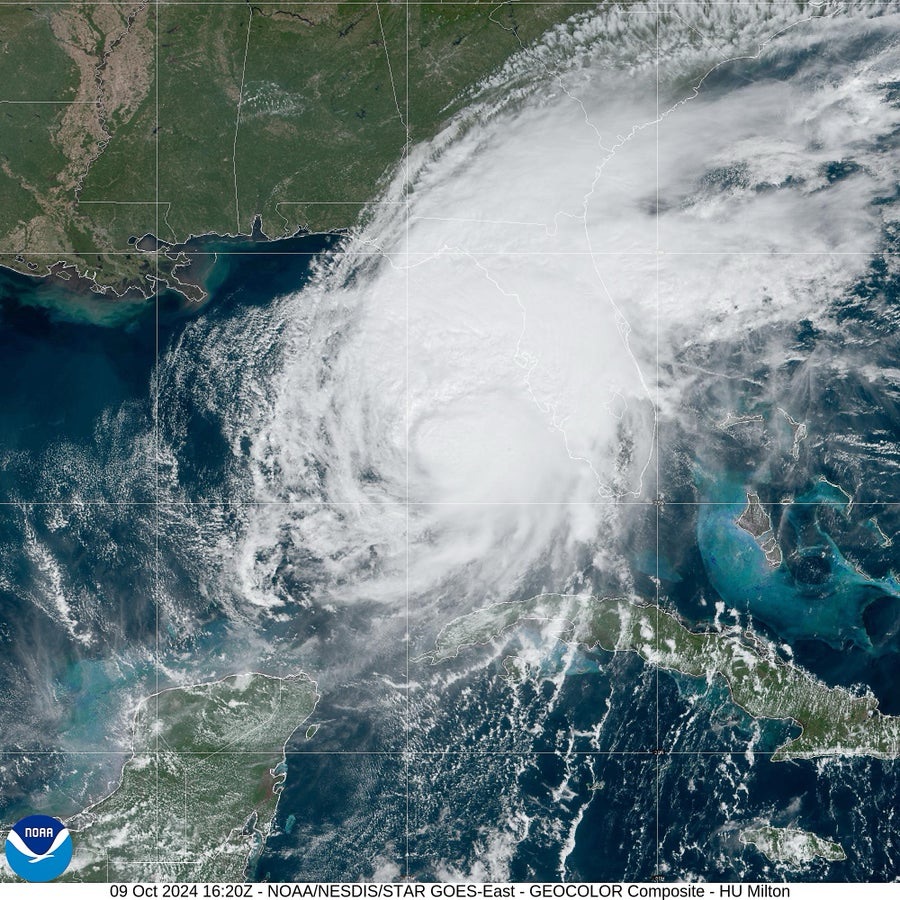
Every year, when Californians enjoy the nip of fall or upstate New Yorkers wake up to lawns of ice-frosted grass, Floridians welcome hurricane season. Before even the suggestion of a rain storm appears off the western coast of Africa, Floridians review their annual stock of canned goods and bottled water. They test gas generators and repair hurricane shutters. Hospitals review emergency survival guidelines. Everywhere from South Florida to Gainesville, people prepare for deadly storms that span the entire width of a state, and they do this every year, year after year. When I lived in Florida, I survived many hurricanes. Several storms develop every season. You learn which are worth keeping children home for and which are only umbrella fodder, and when a real threat emerges — which is often — you rush to make your final preparations, and then you wait for the hurricane to hit. You sit in your house or your apartment and watch the slow inexorable advance of a monstrous force you can do nothing to prevent. For some reason, people still live there. It boggles my mind.
I feel the same about the impending Trump presidency. We know how the first one went, so we can also begin prepping for the storm to come. We have access to resources, to political shutters, and we have communities we can join. We have two hundred years of infrastructure. We have complicated laws that four years or fifty cannot unravel — and that does not take into account the forces fighting such destruction. In this election alone, seven states enshrined abortion in their constitution. The process does not stop here; it’s just beginning.
I know the discourse around a potential Trump presidency made it sound like the end of democracy, and I went along with that line of thinking. But I see this as a battle lost, not a war. Yes, Trump’s first four years ushered in the loss of bodily rights, the rollback of civil rights and LGBTQ gains, and the stacking of the Supreme Court with dishonest ultra-conservative justices, but it also saw many states rush to ensure protections for the same populations targeted in those minority communities.
We also saw former republicans rethink the direction of the party and start the process of establishing a new political force that took steps never before seen like canvassing and voting for democratic candidates. This latest loss will further drive Republicans to redefine their political identity in ways that will benefit fundamental civic rights. Fiscal Republicans and independents are abandoning the party whose illiberal social positions they can no longer tolerate. That will not change. They cannot stop at having desperately voted for Harris in the hopes of preventing a Trump administration. They have to reckon with the world they contributed to creating, and this means their work of rejecting their former party must continue. It won’t stop at the one vote because that wasn’t enough. They cannot now return to the party they once knew because it is gone.
Democrats face a similar rebuilding of the party from the ground up — a challenge we are ready and able to confront. Democratic politicians have failed their constituents. Voters in Hawaii to New Mexico to New York feel betrayed after decades of voting Democrats into power only for those Democrats to avoid every opportunity to pass meaningful legislation for their constituents. We have seen the far left violently clash with the progressive base, and this conflict requires the same kind of soul searching we are seeing from Republicans and will lead to inevitable political momentum and change. The left focuses on the U.S.’s international policies that led to violence, death, and oppression in other countries, using this history to justify a collective punishment of America today. There is no question that previous U.S. administrations and power brokers have contributed to the destruction and suffering of countries throughout the world, but we aren’t the same U.S. as we were then, and the world is not the same world. Previous regimes around the world exerted power under very different societal circumstances. The U.S. today is not Soviet Russia or North Korea or Nazi Germany. We can act differently without punishing ourselves for the sins of the past. It is time to let go of the spirit of the Protestant work ethic as a national moral guide.
Yet it is not enough for us to examine these inflection points alone. We need to examine the narrative underpinning these conditions and understand why the stories we tell are responsible for our current state. There is a certain privilege Americans possess which makes it possible to dismiss the threat of a Trump presidency. This privilege is evident in how the average American sees the social challenges they face as comparable to far more extreme political realities. We have repurposed the language we use to frame ourselves, one another, and the social architecture where we enact our lives. We have broadened the ways in which we understand our place in the American narrative. We borrow historically weighted terms like “oppression” and “genocide” and “fascism” and apply them to circumstances far removed from the original events those terms were created to describe. This has helped foment a delusion that our privileged lives and our privileged hardships require the same catastrophic responses and allocation of societal resources and attention as, for example, Soviet Russia or the Holocaust required. We need a reality check, and we need to stop using nuclear tier terminology to describe modern issues that do not require a state of emergency to address. Our problems may be dire, but they are issues we have the infrastructure to confront.
A second Trump term might also mean we lose the final shreds of U.S. legitimacy and standing on the world stage, but that doesn’t mean we don’t have the resources to rebuild toward a new national identity and a stronger international position. Whether or not they realize it, this result is what many angry citizens on the left and right wanted. From the right calling for violence against progressive ideals or the left calling for us to burn it down by any means necessary, we brought this moment into being. Yet the death knell is not uniformly distributed in the American landscape. There are still Walmarts and Holiday Inns and all access passes to Disneyland and strip clubs and Jack in the Boxes. The iPhone 17 is being designed even as the iPhone 16 released this year, and grocery store chains still stock ten different brands of toilet paper. You may think these are trivialities, but it’s precisely the ocean of excess that could end up preventing the successful establishment of a totalitarian regime.
The same inertia we have struggled to overcome as leftists is the same inertia the right has to face, so while the states will undergo change, and we will lose humans and spaces to entirely preventable circumstances, there are spaces and ways of living in this country that can’t be walked back, and that matters.
We are smart, and we have more resources available to us than we realize. We often say elections in the U.S. are fundamentally unserious because of how flawed the electoral process is, which also means we can exploit those same weaknesses to protect our communities. We have more aggregate resources, public infrastructure, and global technology than people in the past did. And while Scherbina in HBO’s Chernobyl says “every generation must know its own suffering,” I can’t help but feel our current generations have lived through our suffering for a long time, and we know it well. We still have lives and communities that make existing worth it. I am so grateful for that. The challenges before us make life more worth surviving and our ideals more worth preserving. So be kind to yourself today and chin up. We’ve got this.

 Snail Ask Why
Leave a comment