
In the aftermath of the recent Amsterdam Pogrom, a number of articles reported on the tragic event — many in ways that perpetuate antisemitism, and they used common linguistic strategies to do so.
Using this one headline, let’s look at how journalists commonly use language to delegitimize violence against Jews, to blame Jews for that violence, and to reinforce antisemitic discourse by questioning the veracity of verified Jewish reports.
Please note the original has been removed, so this screenshot from a post on X was used.
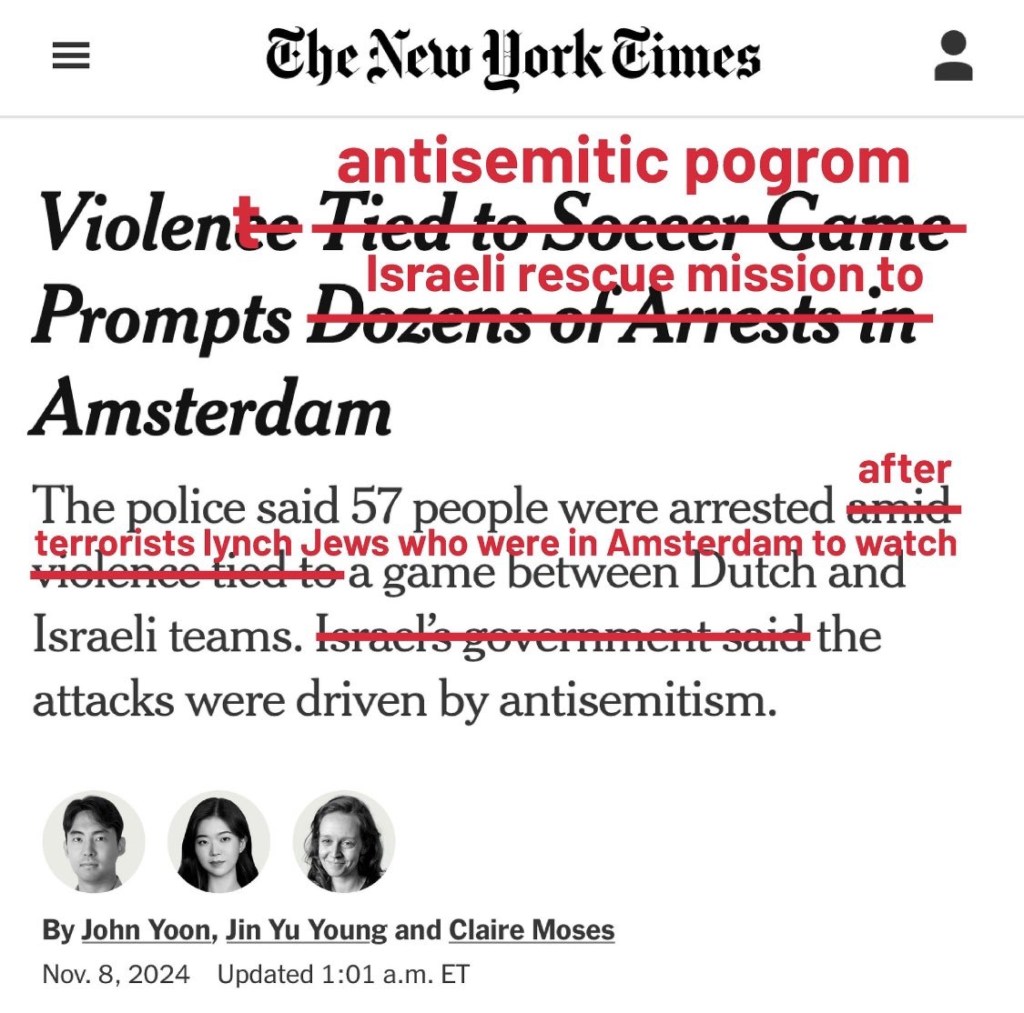
“Violence tied to soccer game”
The first four words of the headline signal to the reader the main point of the piece — and it’s not violence against Jews but a scuffle between sports fans. By opening with a generic reference to sport fan violence, the article suggests to readers the key takeaway is “humdrum football clash between rivals.” Countries where football is popular are primed to understand sports violence happens; it’s not necessarily racially driven. By framing the pogrom in this way, journalists delegitimize violence against Jews before readers even get to the article. In contrast, notice the first five words in this Forward headline and how it changes the framing of the event: “antisemitic hit and run squads”.

Furthermore, by minimizing the pogrom as business as usual violence when Jews are loudly reporting them as targeted, pre-meditated attacks, journalists subtly suggest Jews are exaggerating — a common antisemitic tactic where people refer to Jews or Zionists as “crybabies” who make a big deal out of nothing.
“Israel’s government said”
You will spot many articles tacking this onto headlines and sentences that report facts about Israel or Jews. Journalists generally use language like “according to X” or “X alleged” to protect themselves from news that might turn out not to be true. When they use such language about verified attacks, they imply to readers seasoned in basic news reporting that Israel might be lying. At a time when people volubly distrust Israel, such a framing signals to the reader that they should take what follows with a grain of salt. All before they have even read the article. This also subtly reinforces the false claim that Jews weaponise antisemitism to garner sympathy in order to normalise its treatment of Palestinians.
In just two short phrases, we see how journalists across different periodicals employ stock language to subtly cast Israel, Israelis, and Jews as untrustworthy exaggerators, and we know very well how a moral world treats untrustworthy exaggerators. Do better, journalists.

 Snail Ask Why
Leave a comment